Position Sharing · PLI
Keep your team visible without cellular coverage.
Share position location information (PLI) across a LoRa mesh, so every connected ATAK client sees where the team is — even when there's no network at all.
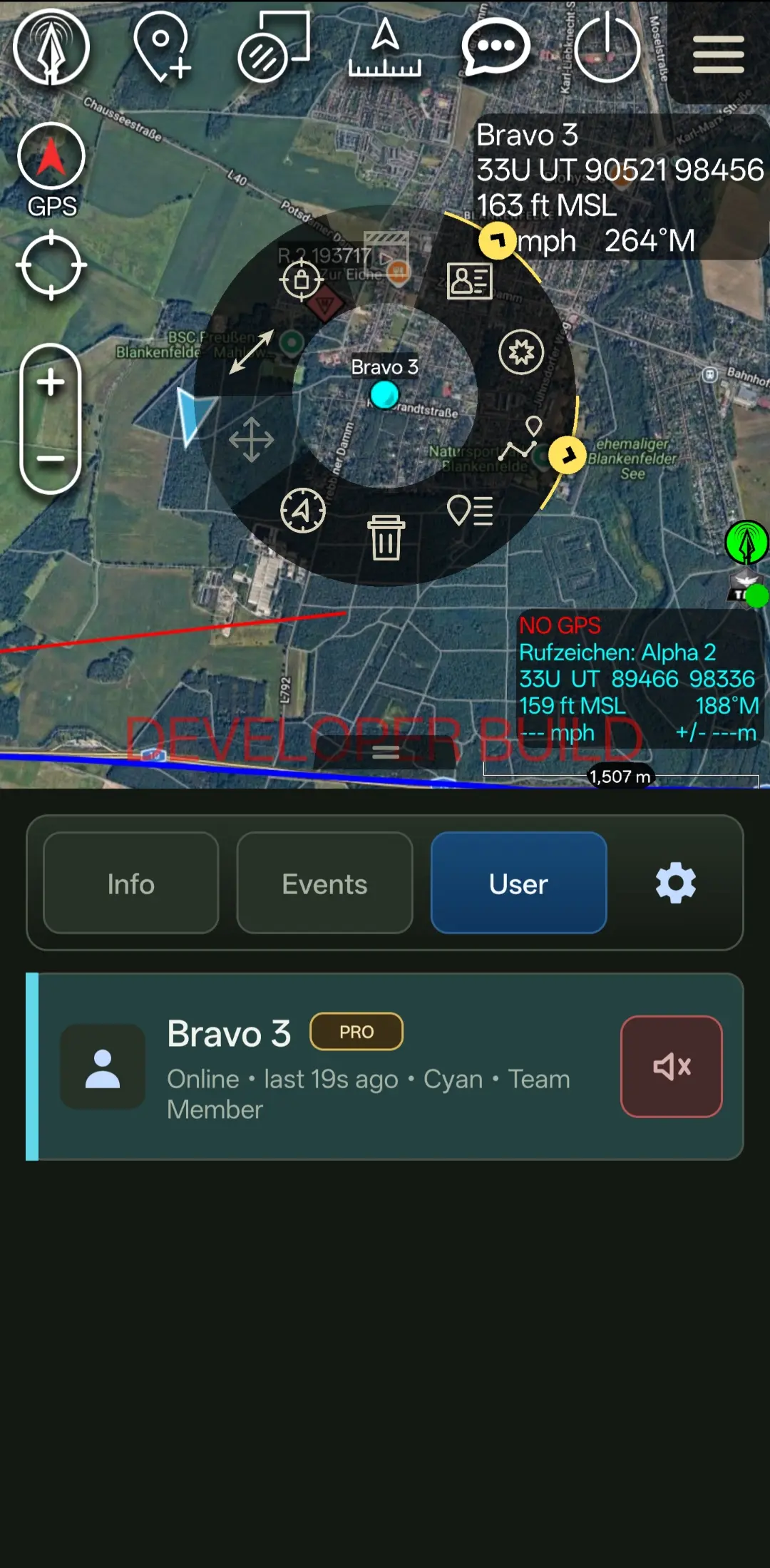
Your position is packaged into a compact frame and forwarded hop-by-hop across the mesh. Each connected ATAK client rebuilds it as a native contact on the map, with call sign and grid reference intact.
LoRa trades bandwidth for range. Updates arrive on an interval — not continuously — and travel as far as the mesh can carry them. LANCE surfaces hop count, RSSI and SNR so you can read the link honestly before you depend on it.
Every byte counts on LoRa. LANCE optimizes the PLI payload and lets you tune update frequency, so a larger team doesn't saturate the channel. The result is a usable picture within the constraints of the radio.
There's nothing new to learn. Position sharing happens inside ATAK exactly as it always has — LANCE simply changes the transport underneath from cellular and TAK Server to Meshtastic or MeshCore and LoRa.
Teammates appear in the LANCE user list as soon as they join the mesh — even before their device has a GPS fix. They are only placed on the map once a real position arrives, so nobody is ever shown at a false location. Identity frames carry team colour, role and the device battery level, so the list stays accurate from the first frame.
If your radio has its own GPS, LANCE Pro can use it as the position source for your ATAK self marker and outgoing PLI. Only fresh fixes are used; the polling interval is selectable, and a vehicle profile adds heading and speed.
Figures are indicative LongFast planning guidance and depend on hardware, terrain, region, preset and channel load. Roughly five devices at a 30 s cadence already approach 8% aggregate channel airtime before markers, shapes or chat. See the wiki for details.